
A good transactional email service will deliver your emails to the recipients’ inboxes quickly and flawlessly, without landing in spam. Password resets, account confirmations, purchase receipts, security alerts, and onboarding messages need to be delivered, and fast.
Based on our research, the best transactional service providers are Mailtrap, SendGrid, Mailgun, Amazon SES, and Postmark. We compared each provider on deliverability, infrastructure, pricing, and support to help you pick the right one for your stack.
Best transactional services: a quick overview
Here's how the top five transactional email providers stack up:
| Provider | Main focus | Free Plan | Pricing Starts From | SDKs |
|---|---|---|---|---|
| Mailtrap | High email deliverability with industry-best analytics | 4,000 emails/month | $15/month (10K emails) | Node.js, Ruby, PHP, Python, Elixir SDKs |
| SendGrid | Transactional + marketing in one platform | 60-day free trial; 100 emails/day | $19.95month (50K+ emails) | Multiple SDKs + extensive integrations |
| Mailgun | API-first sending with real-time email validation | 100 emails/day | $15/month (10K emails) | Python, PHP, Java, Ruby, .NET |
| Amazon SES | AWS-native apps prioritizing cost at scale | 3,000 emails/month (from EC2) | $0.10 per 1,000 emails | AWS SDKs |
| Postmark | Fast delivery with separate message streams | Free trial only | $15/month (10K emails) | Multiple libraries |
How we choose and compare transactional email providers
Here's what we tested: infrastructure reliability, integration complexity, pricing at scale, and support quality.
Email infrastructure
Your infrastructure determines whether emails reach inboxes or land in spam folders. Three factors matter most: deliverability, scalability, and reliability.
Deliverability starts with IP reputation — it's how recipient servers decide whether to trust your emails. Here's how each provider handles it:
- Mailtrap offers separate streams for transactional and bulk email on all plans to prevent reputation mixing. Also, a dedicated IP is available with automatic warm-up schedules. The platform automatically builds sender reputation by gradually increasing sending volume.
- SendGrid provides shared IPs for smaller senders and dedicated IPs for high-volume accounts. You can use SendGrid’s automated warmup feature or API for warmup, only note that the feature requires some manual configuration.
- Mailgun uses shared IP pools by default, with dedicated IPs available from the Foundation plan and above. And the service has developed an automatic warmup feature.
- Amazon SES starts all accounts on shared IPs. Dedicated IPs cost $24.95/month each. New accounts enter "sandbox mode" with sending restrictions until you prove sender quality.
- Postmark operates on shared IP pools optimized for transactional email. Dedicated IPs available for high-volume senders. Strict policies ensure shared IPs maintain a good reputation.
Scalability varies significantly. Mailtrap and SendGrid offer managed infrastructure that scales with your needs without requiring DevOps expertise. Amazon SES handles virtually unlimited volume at the lowest cost. Mailgun and Postmark provide solid mid-range scalability with clear volume tiers.
Reliability goes beyond uptime percentages. It includes API response times when you're sending thousands of password resets during traffic spikes. SMTP connection stability during peak hours, and the recovery speed when infrastructure issues occur.
Mailtrap, Sendgrid, and Mailgun maintain 99.99% uptime SLAs. Mailtrap adds Ruby on Rails’ ActionMailer Balancer for automatic failover. If one connection fails, emails route through the backup infrastructure automatically.
Global infrastructure matters for sending speed and compliance. SendGrid, Amazon SES, and Postmark operate servers in multiple regions globally. Mailtrap and Mailgun focuses on US and EU regions. Regional sending can improve delivery times and helps meet data residency requirements.
Ease of integration
Developer experience determines whether you're sending emails quickly or spending days navigating documentation.
| Provider | Code Snippets | Official SDKs | Setup Complexity |
|---|---|---|---|
| Mailtrap | 25+ ready-to-use code snippets | Node.js, Ruby, PHP, Python, Elixir | Low |
| SendGrid | Comprehensive library | Most major languages | Medium |
| Mailgun | Developer-focused | Python, PHP, Java, Ruby, .NET | Low |
| Amazon SES | AWS documentation | All AWS SDK languages | Medium-High |
| Postmark | Simple examples | Multiple languages | Very Low |
Mailtrap enables quick integration with minimal configuration time. That includes copy-paste code examples and clear authentication. Note that the Mailtrap transactional service provides both API and SMTP options with straightforward setup.
SendGrid has extensive features, which require more learning time. Valuable if you need advanced automation, but more than necessary for simple transactional sending.
Mailgun offers a good balance, but you should keep in mind that it’s API-first design. The silver lining is Mailgun’s strong documentation.
Amazon SES integrates well if you're already in AWS. Otherwise, expect to learn IAM roles, security groups, and AWS-specific concepts. The learning curve is significant.
Postmark provides simple integration. Streamlined specifically for transactional email. Focused feature set. Fast, reliable sending with clear documentation.
Pricing
Amazon SES offers the lowest per-email cost. $0.10 per thousand emails after the free tier. However, that's bare infrastructure. No dashboard. No templates. No analytics. You build everything yourself or use third-party tools.
Mailtrap offers a complete platform at competitive pricing. $15 for 10,000 emails includes advanced analytics, real-time tracking, templates, and deliverability insights. Also, this Basic plan can be extended to 100K emails for $30, but other limitations still apply (number of domains, user seats, etc.)
SendGrid looks more expensive initially but bundles marketing campaign tools. The service makes sense if you need both transactional and promotional capabilities.
Postmark is also on the more expensive side, but it’s well-compensated with deliverability and speed of delivery.
Mailgun sits in the middle, offering specialized features at moderate pricing. Overall, it’s a good value for money if their specific strengths match your needs.
Here’s a quick overview of pricing and features if you, for example, need to send ~100K emails.
- Amazon SES: $10 base + your time building infrastructure + third-party tools for analytics = unclear total cost
- Mailtrap: $30 with specific Basic plan limits or $85 all-in with complete platform = predictable monthly cost
- SendGrid: $34.95 on Essentials plan, or 89.95 on Pro plan= variable cost
- Mailgun: $75-90 with solid features = competitive middle ground
- Postmark: $115 -138 for 125K emails for transactional-only focus = premium for simplicity
Security & compliance
Email handles sensitive customer data. Security isn't optional.
| Provider | Security Features | Compliance | Data Privacy | Authentication |
|---|---|---|---|---|
| Mailtrap | TLS encryption, AES-256, IP whitelisting, API key permissions | ISO 27001, GDPR (DPA available) | EU/US residency options | SPF, DKIM, DMARC, 2FA |
| SendGrid | TLS encryption, SSO support | SOC 2 Type II, PCI DSS, GDPR | US-based | SPF, DKIM, DMARC, SSO |
| Mailgun | TLS encryption, AES-256 at-rest, email content exclusion | SOC 2 Type II, ISO 27001, GDPR | US and EU regions | SPF, DKIM, DMARC |
| Amazon SES | AWS encryption (TLS/AES), VPC integration | SOC 1/2/3, ISO 27001/27017/27018, PCI DSS, GDPR | Global AWS regions | SPF, DKIM, DMARC |
| Postmark | TLS encryption, secure transmission | SOC 2 Type II, GDPR | AWS infrastructure | SPF, DKIM, DMARC |
Every provider supports essential authentication (SPF, DKIM, DMARC). The difference is in implementation quality and additional security layers.
Mailtrap's ISO 27001 certification means independent auditors verified their security controls. IP whitelisting lets you restrict access to specific networks. API key permissions give granular control over who can do what.
Amazon SES benefits from AWS's massive security infrastructure. VPC integration adds network isolation. But you're responsible for implementing most security features yourself.
SendGrid offers SSO for enterprise authentication needs (so do most other providers). Mailgun offers email content exclusion for privacy compliance. Postmark maintains strong security with regular third-party audits.
Bottom line: all five are secure enough for most use cases. Choose based on which specific features your compliance requirements demand.
Support
When emails fail to deliver, responsive support becomes essential.
| Provider | Free Plan Support | Paid Plan Support | Response Time | Channels | Expert Access |
|---|---|---|---|---|---|
| Mailtrap | Email, docs | 24/7 higher plans, priority response | Fast | Email, chat | Deliverability experts |
| SendGrid | Ticket | Chat on Essentials, phone on Pro | Varies by plan | Ticket, chat, phone | Expert services available |
| Mailgun | Ticket | Chat on higher tiers | Business hours | Ticket, chat | TAMs (enterprise) |
| Amazon SES | Forums, docs | Requires AWS support plan | Depends on tier | Forums, AWS support | Solutions architects (enterprise) |
| Postmark | Email, chat | Quick | Email, chat, | Included all tiers |
Mailtrap provides 24/7 support, with deliverability experts, not general support staff. These are specialists who can analyze your specific sending patterns and identify reputation issues.
Postmark is known for responsive support even on lower tiers. Users consistently report helpful responses within hours.
SendGrid's support quality varies dramatically by plan. Free and Essentials users report slow ticket responses. Pro and Premier get much better treatment.
Amazon SES requires separate AWS support contracts. Without a support plan, you're limited to community forums and documentation.
Mailgun offers solid technical support. Chat access on higher-volume plans. Technical account managers for enterprise clients.
Top 5 best transactional services
1. Mailtrap
G2: 4.8, Capterra: 4.8
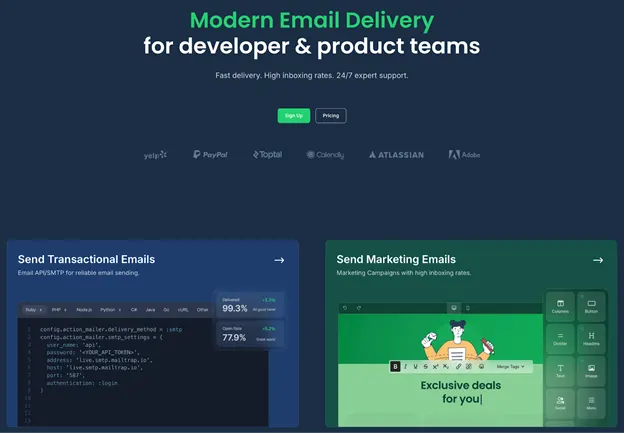
Mailtrap is a modern email platform for developers and product teams. It provides transactional email service with SMTP and API support, focusing on high deliverability, fast delivery, industry-best analytics, and 24/7 expert support.
Key features
- 25+ ready-to-use code snippets for quick integration
- RESTful SMTP API with SDKs for major programming languages
- Separate sending streams for transactional and bulk emails
- MCP server for codeless integration and email sending
- Native integrations with Supabase, Zapier, n8n, and more
- Dedicated IPs with auto warmup
- Auto email authentication with SPF, DMARC, DKIM support
- Industry-best analytics with up to 30 days of email logs
- GDPR and SOC2 compliance; ISO/IEC 27001:2022 certified
Pros & cons
Pros
- High inbox placement rates
- Fast integration, excellent SDKs support and clear docs
- 24/7 expert support
- Prevents reputation damage with separated email streams
- Enterprise-level security and compliance
Cons
- Advanced automations only via API
- Dedicated IPs and extended log retention require paid plans
Pricing
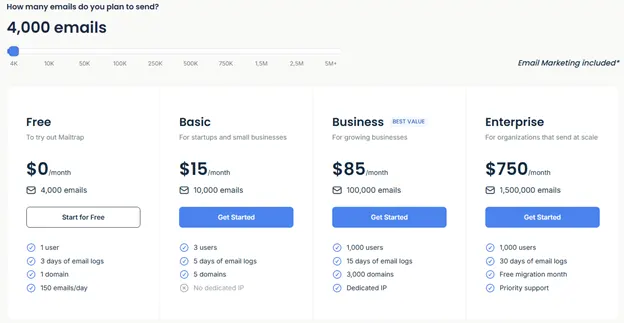
Mailtrap offers a generous free tier with 4,000 emails/month including webhooks, analytics, and suppression management. Paid plans start at $15/month for 10,000 emails, with the popular Business plan at $85/month for 100,000 emails including dedicated IPs and 15-day log retention.
For more details, you can visit Mailtrap’s pricing page
2. SendGrid
G2: 4.5, Capterra: 4.2
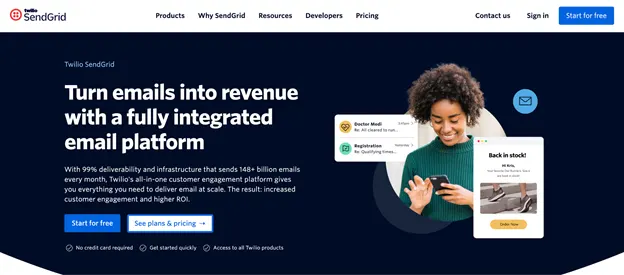
SendGrid, a Twilio company, is one of the most widely adopted transactional and marketing email delivery platforms. It’s known for its cloud-native scalability, strong deliverability reputation, and robust infrastructure.
Key features
- Cloud-native infrastructure with proven scalability
- RESTful Email API with SDKs in major programming languages
- Dedicated IPs and custom domain authentication
- Real-time analytics with engagement metrics and geolocation data
- A/B testing and deliverability optimization tools
- Suppression management and email validation APIs
- Native integrations with Twilio, Zapier, and Marketing Cloud
- GDPR and SOC2 compliance with enterprise-grade SLAs
Pros & cons
Pros
- Scalable and reliable infrastructure
- Detailed analytics and testing tools
- Extensive API documentation and developer resources
- Strong integration ecosystem
Cons
- Deliverability can vary without dedicated IPs
- Premium features like subuser management and dedicated IPs require higher-tier plans
Pricing
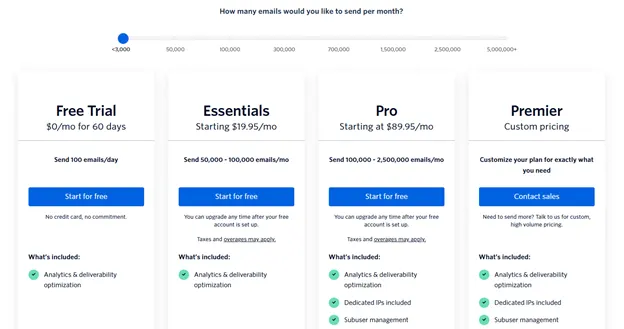
SendGrid’s pricing starts at $19.95/month, including 50,000+ emails. The Essentials plan covers mid-volume senders (50-100K emails a month), while Pro tiers (around $89.95+/month for 100,000+ emails) unlock dedicated IPs and advanced analytics. Premier plans scale beyond 2,500,000 emails with custom SLAs and pricing.
For more details, you can visit SendGrid’s pricing page
3. Mailgun
G2: 4.2, Capterra: 4.3
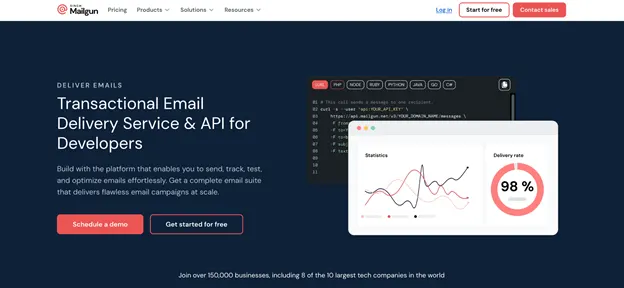
Mailgun is a developer-focused email delivery platform known for its precise deliverability controls and deep analytics. It also has SMTP and it’s designed for teams that want granular control over sending, tracking, and optimizing transactional and bulk email performance.
Key features
- API with advanced routing and tagging
- Real-time tracking of opens, clicks, and unsubscribes
- Flexible IP pools and custom domain authentication
- Detailed event logs with webhook support
- Email validation API and verification tools
- Deliverability reports and reputation monitoring
- SMTP relay and REST API sending options
- Native integrations with Zapier, n8n, and HubSpot
- GDPR, SOC2, and ISO27001 certified
Pros & cons
Pros
- Granular API control and event management
- Strong deliverability tools and verification APIs
- Transparent logging and analytics
- Developer-friendly setup
Cons
- Pricing grows quickly with higher volumes
- Dedicated IPs and advanced analytics limited to higher-tier plans
Pricing
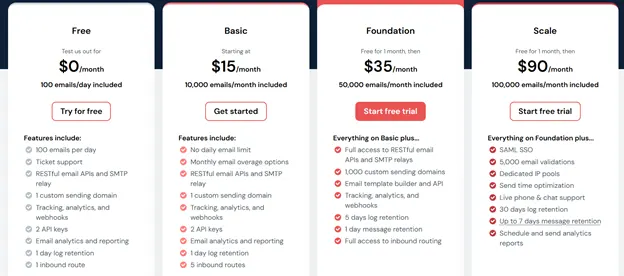
Mailgun starts at $15/month for up to 10,000 emails. It uses volume-based tiers, with pricing around $75–90/month for 100,000 emails. Advanced plans include dedicated IPs, validation APIs, and priority support.
For more details, you can visit Mailgun’s pricing page
4. Amazon SES
G2: 4.3, Capterra: 4.7
Amazon Simple Email Service (SES) is a high-performance, pay-as-you-go SMTP relay built for developers and enterprises that need reliable, low-cost email delivery. Backed by AWS infrastructure, it offers massive scalability, strong security, and advanced configuration options through IAM policies and AWS integrations.
Key features
- Pay-as-you-go model
- SMTP and RESTful API support
- AWS console and SDK integration (Lambda, S3, CloudWatch)
- Dedicated IPs and reputation management tools
- Real-time metrics and CloudWatch-based monitoring
- Multi-region availability for global delivery
- GDPR and ISO/IEC 27001 compliance
Pros & cons
Pros
- Lowest cost per email in the market
- High reliability and scalability via AWS backbone
- Full API and AWS service integrations
- Flexible, developer-oriented configuration
Cons
- Requires technical expertise to set up, maintain, and scale
- No native dashboard or built-in analytics for non-AWS users
Pricing
Amazon SES is free for the first 62,000 emails from EC2 instances. Outside AWS, pricing averages $1 for 10,000 emails, scaling to $10 for 100,000 and $50 for 500,000 emails. Dedicated IPs and reputation dashboards are optional add-ons. Also, keep in mind that AWS has very nuanced pricing, where they also factor in data transfers, so it’s best to check all the details at their official page.
5. Postmark
G2: 4.6, Capterra: 4.7
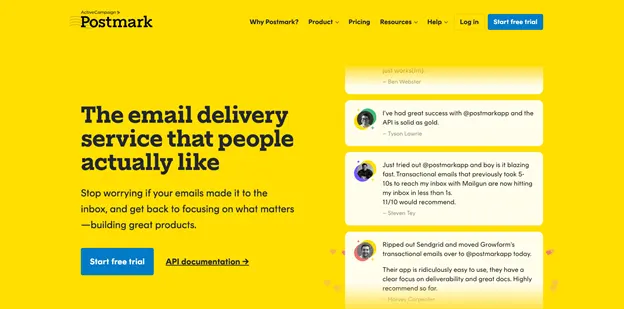
Postmark is a transactional email service focused on speed. It offers a separate broadcast stream for bulk messages, but the platform is built around transactional use cases rather than bulk sending.
Key features
- Dedicated infrastructure for transactional emails
- Detailed delivery, open, and bounce tracking
- Webhooks and inbound email processing
- SMTP and RESTful Email API support
- DMARC, DKIM, and SPF authentication
- Log retention and searchable message history
- Native integrations with Zapier, n8n, and Slack
- GDPR and SOC2 Type II compliance
Pros & cons
Pros
- Good delivery speed
- Transparent event tracking and searchable logs
- Simple setup and developer-friendly APIs
- Clear documentation
Cons
- Dedicated IPs only available at 300k+ monthly volume
- Support quality varies following ActiveCampaign acquisition
Higher price per email compared to SES or SendGrid
Pricing
Postmark starts at $15/month for 10,000 emails, scaling to $55-66 for 50,000 and $115-138 for 100,000. Note that the ranges indicate pricing differences between different plans. Pricing includes all features, dedicated IPs for higher tiers, and 45-day message retention. At higher volumes, Postmark costs more per email than alternatives like Mailtrap, SendGrid, Mailgun, or Amazon SES.
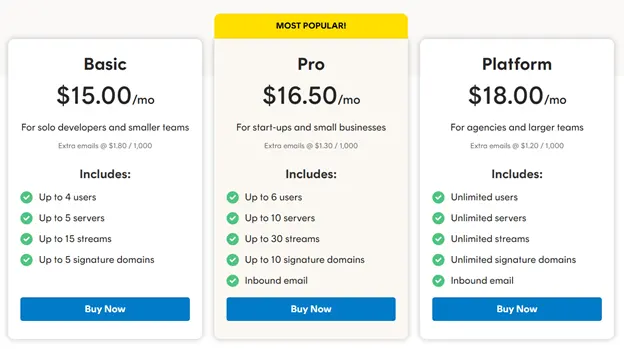
For more details, you can visit Postmark’s pricing page
Wrapping up:
The best transactional email services are Mailtrap, SendGrid, Mailgun, Amazon SES, and Postmark. Each one excels in different scenarios. Your choice depends on technical requirements, sending volume, feature needs, and budget.
Here's when to use each provider:
Use Mailtrap when you need the complete package. High deliverability. Comprehensive analytics.. Excellent support. Mailtrap is the top choice for development teams and product companies refusing to compromise on email infrastructure quality. With 25+ ready-to-use code snippets, SDKs for major languages, and native integrations with Supabase and Zapier, Mailtrap gets you sending in minutes.
Use SendGrid when you're an enterprise requiring both transactional and marketing email in one platform. You need extensive third-party integrations or advanced automation features. SendGrid works best for larger organizations with dedicated email teams who can leverage the full feature set.
Use Mailgun when you're building applications with complex inbound email routing requirements. You need API control over email sending or flexible email parsing capabilities. Mailgun fits developer-heavy teams comfortable with API-first tools.
Use Amazon SES when you're already deeply invested in the AWS ecosystem. You need the absolute lowest cost per email at high volumes or seamless integration with other Amazon services. SES makes sense for technical teams who can handle setup complexity in exchange for significant cost savings.
Use Postmark when you only send transactional emails and need fast delivery. It's reliable and simple, but expect to pay more per email than Mailtrap, SendGrid, or SES as volume grows.
For most development teams prioritizing reliability, analytics, and ease of use, Mailtrap emerges as the best overall choice. The platform delivers consistently high inbox placement rates while providing the comprehensive tooling modern applications need.
Combined with transparent pricing and expert support, Mailtrap offers the strongest value proposition for teams serious about email delivery.
Ready to ensure your transactional emails reach the inbox? Start with a provider that matches your technical expertise and scales with your growth.
FAQ
1. What is the best transactional email provider?
Mailtrap and Postmark tie for best transactional email providers, though for different reasons.
Mailtrap is the best transactional email provider for most teams. It combines high deliverability with actionable analytics, 25+ ready-to-use code snippets, and fast setup—most developers send their first email within 5 minutes.
Postmark is a solid alternative if sub-second delivery speed is your top priority. It supports bulk email through a separate broadcast stream, but pricing runs higher than competitors at scale.
Both maintain pristine sender reputations through strict anti-spam policies and proactive infrastructure management.
2. What transactional email service provides the best developer experience?
Mailtrap provides the best overall developer experience with ready-made SDKs for Node.js, Ruby, PHP, Python, and Elixir. You can debug emails safely before production deployment.
The platform combines comprehensive documentation, copy-paste code examples, and fast integration. Most developers send their first email within 5 minutes.
Mailgun runs close second for developer experience with API-first design and powerful inbound routing capabilities.
3. What transactional email service provides the best email deliverability rate?
Mailtrap consistently achieves the highest deliverability rates at 99%+ for transactional emails through a combination of dedicated IP pools, automatic IP warm-up, and proactive reputation management.
Postmark matches these deliverability rates for pure transactional sending by refusing to handle bulk marketing emails that could impact sender reputation.
Both providers significantly outperform general-purpose services that mix transactional and marketing traffic on the same infrastructure.
4. What's the difference between transactional and marketing email services?
Transactional email services specialize in sending triggered, one-to-one emails like password resets, purchase confirmations, and account notifications that users explicitly expect. These services prioritize speed, reliability, and inbox placement since delivery directly impacts user experience.
Marketing email services focus on one-to-many promotional campaigns with features like segmentation, A/B testing, and campaign analytics.
The key difference lies in sending reputation management. Transactional services maintain stricter anti-spam policies and dedicated infrastructure to ensure mission-critical emails always reach the inbox. Marketing services balance bulk sending capabilities with deliverability.
Using the same service for both risks your transactional email reputation if marketing campaigns generate spam complaints.
